 Trailers
 Buses
Buses
 Tractors
 Rollers
 Cranes
 Loaders
 Graders
 Forklifts
 Dozers
 Excavators
 Boats
Boats
 Caravans





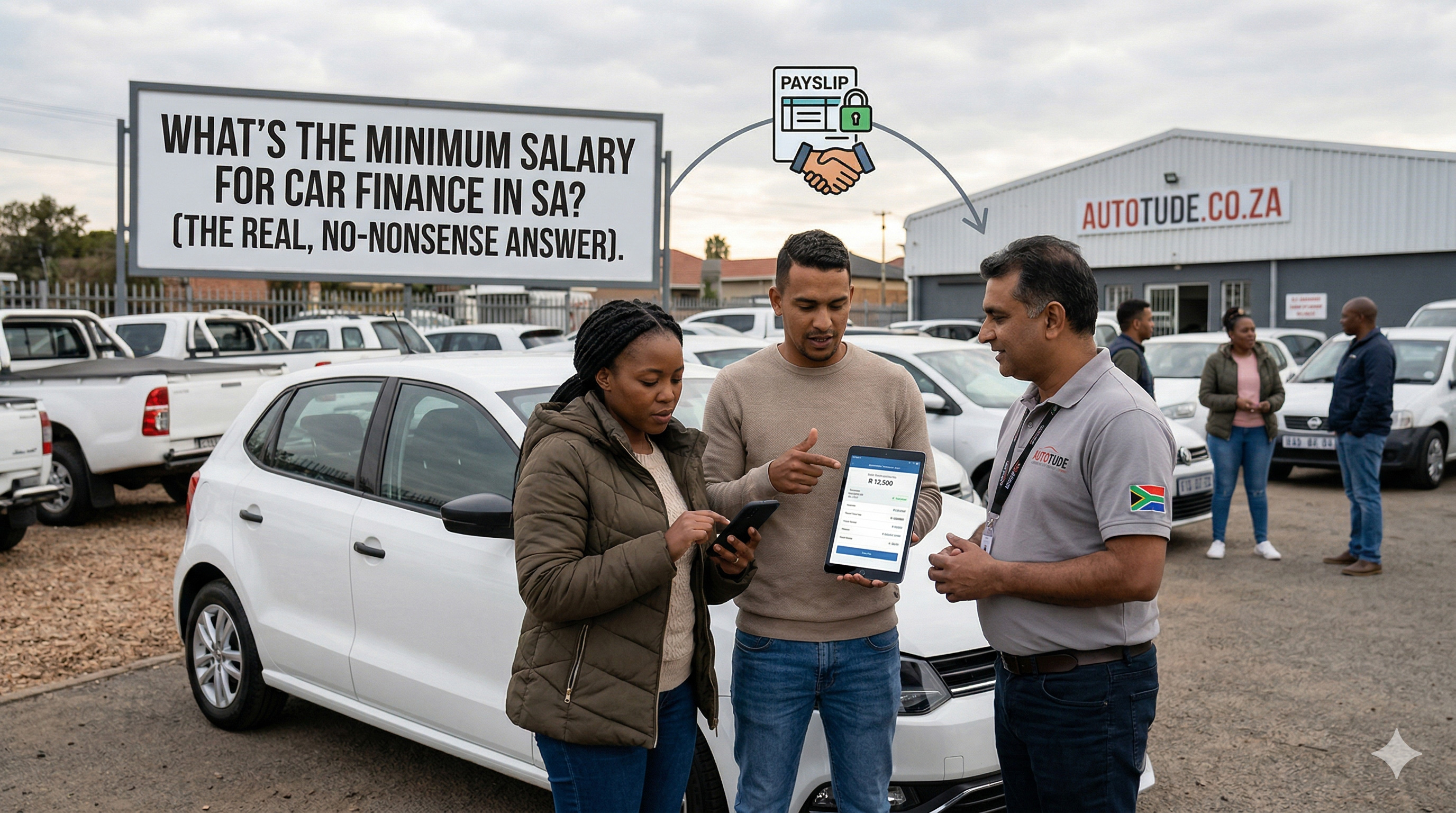
What’s the Minimum Salary for Car Finance in SA? (The Real, No-Nonsense Answer)
You’ve been scrolling through an Auto Marketplace platform, you’ve found a car that fits your vibe, and now you’re wondering: "Can I actually afford this? Will the bank even look at me?"
You’re not alone. Every day, thousands of South Africans ask the same question. And the answer isn't as simple as "earn R10k and you're good."
Here’s the honest truth about car finance in South Africa—no jargon, no fluff, just real talk.
First, The Numbers You Actually Want
Let's start with what the major banks say on paper :
Bank / Lender Minimum Monthly Salary Standard Bank R5,000 FNB R6,000 MFC (Nedbank) R6,500 WesBank R7,500
Now, before you get excited thinking you can finance a BMW with a R5,000 salary, let me stop you right there.
These are the absolute minimums to even apply. They are not guarantees. And they are certainly not what you should aim for if you want to stay financially sane.
The Real Rule Banks Don't Always Tell You
Here’s the golden rule that responsible lenders actually use:
Your monthly car instalment shouldn't eat up more than 8–10% of your take-home pay.
And your total car costs (instalment + fuel + insurance + maintenance) should stay under 16–20% of what you bring home .
Let me translate that with real numbers:
If you take home R15,000 per month:
-
Safe instalment: R1,200 – R1,500
-
Total monthly car cost: R2,400 – R3,000
If you take home R20,000 per month:
-
Safe instalment: R1,600 – R2,000
-
Total monthly car cost: R3,200 – R4,000
If you take home R30,000 per month:
-
Safe instalment: R2,400 – R3,000
-
Total monthly car cost: R4,800 – R6,000
Notice something? Even at R30,000 take-home, the banks' "minimum" salary of R5,000 is irrelevant. You need to look at what you can actually afford after rent, food, data, electricity, and that Netflix subscription.
What R5,000 Per Month Actually Buys You (Be Honest With Yourself)
Let's say you want to keep your monthly instalment at R5,000. What kind of car can you get?
Generally speaking, a R5,000 monthly instalment will get you a vehicle in the R180,000 to R250,000 price range, depending on your interest rate, deposit, and loan term .
Here are real examples from the South African market :
Car Estimated Monthly Instalment 2014 Toyota Etios R3,200 – R4,200 2021 Volkswagen Polo R4,800 – R5,000 2015 BMW 120i (used) R4,900 – R5,000
But here's the kicker: the instalment is not the full story.
The Hidden Costs That Destroy Budgets (Every Single Month)
I've watched friends celebrate getting approved for car finance, only to cry six months later when they realise their "affordable" car is eating them alive.
Let me show you what a R373,800 Volkswagen Polo 1.0TSI actually costs per month :
Cost Item Monthly Amount Loan instalment (60 months, 11.25%) ±R8,250 Fuel (1,000 km/month) ±R1,120 Insurance ±R1,100 Maintenance & repairs (average) ±R2,180 TOTAL ±R12,650
Wait, what? R12,650 per month for a car that "costs" R8,250?
Yes. And that's before toll gates, car washes, parking fees, and the inevitable unexpected repair.
This is why many financial experts suggest a simple shortcut: double your instalment. That's roughly what you'll actually spend each month to own and operate the car .
So if you're looking at a R5,000 instalment, you should realistically have R10,000 per month available for car expenses.
The 3x Rule: A Quick Reality Check
Many lenders use a simple formula behind the scenes: Your monthly instalment should be no more than one-third of your take-home pay .
Let me put that in a table so it's crystal clear :
Your Take-Home Pay Maximum Safe Instalment Realistic Car Price Range R10,000 R3,300 R90,000 – R120,000 R15,000 R5,000 R180,000 – R250,000 R20,000 R6,600 R240,000 – R330,000 R30,000 R10,000 R360,000 – R450,000
See how that works? If you earn R15,000, your sweet spot is a R5,000 instalment, which gets you into that R180k–R250k used car range.
What the Banks Actually Check (Beyond Your Salary)
Here's something most people don't realise. Banks don't just look at your salary and say "yes" or "no." They run a full financial background check .
Your Credit Score Matters—A Lot
A good credit score can:
-
Get you a lower interest rate
-
Reduce your monthly instalment
-
Save you tens of thousands of rands over the loan term
A bad credit score? Higher interest rates, bigger deposits, or straight-up rejection.
Your Existing Debt
The bank looks at your debt-to-income ratio—how much of your salary is already committed to other loans, credit cards, and store accounts. If you're already paying R5,000 towards other debt, they won't approve another R5,000 car instalment, even if you earn R20,000.
Your Employment Stability
Permanent employment with at least 3–6 months at the same job looks good. Recent graduate? Freelancer? Self-employed? You'll need more paperwork (bank statements, tax returns, proof of income).
Required Documents (Get These Ready)
-
Valid South African ID
-
Driver's licence
-
Last 3 months of payslips
-
Last 3 months of bank statements
-
Proof of residence (less than 3 months old)
What About a R5,000 Salary? Can You Really Buy a Car?
Technically, yes. Practically? It's brutal.
Let's do the maths on a R5,000 monthly salary :
-
Essential living costs (rent, food, transport, utilities): R3,000 – R3,500
-
Remaining for everything else: R1,500 – R2,000
-
Car instalment should be: no more than R1,000
At R1,000 per month, you're looking at a car price of roughly R90,000 to R120,000—think older models, high mileage, potentially higher maintenance costs.
And that R1,000 instalment doesn't include insurance (R500–R1,500), fuel, or maintenance.
Is it possible? Yes. But you'll be living on a tightrope. One unexpected repair could break the bank.
Special Case: What If You're Under Debt Review?
If you're under debt review, traditional bank finance is essentially off the table. The National Credit Act (NCA) generally prohibits new credit while you're in this process .
However, there is a legal alternative: rent-to-own programmes. These aren't classified as "credit" under the NCA, so the debt review flag doesn't automatically disqualify you. But you must:
-
Prove you can afford the rental payment outside your debt review plan
-
Inform your debt counsellor before signing anything
-
Be extremely wary of predatory lenders who target desperate people
If you're in this situation, do not lie about your status. And never pay large upfront "admin fees" .
Interest Rates in 2026: What You Need to Know
As of early 2026, the South African Reserve Bank has kept the repo rate at 6.75%, meaning the prime lending rate sits at 10.25% .
What does that mean for you?
Car finance interest rates typically range from 7.60% to over 14%, depending on your credit profile. A good credit score gets you closer to the lower end. A poor score pushes you to the higher end .
On a R200,000 loan over 60 months, the difference between 9% and 14% interest is roughly R30,000 in extra payments. That's not nothing.
Practical Tips Before You Apply
1. Check Your Credit Score First
You can get a free credit report from TransUnion, Experian, or Compuscan. Know where you stand before a bank tells you.
2. Save a Deposit
Even R10,000–R20,000 reduces your monthly instalment and total interest dramatically. It also shows the bank you're serious .
3. Keep Your Loan Term Reasonable
A 72-month loan gives lower monthly payments but costs way more in interest. A 60-month loan is the sweet spot for most people .
4. Be Honest About Your Budget
Don't let the excitement of a new car make you stupid. If the numbers don't work, they don't work. There's always another car.
5. Get Pre-Approved
Walk into a dealership with pre-approval from your bank. It puts you in a stronger negotiating position and stops you from falling for "we can get anyone approved" dealership tricks.\
The Bottom Line
There's no single "minimum salary" that guarantees car finance. The banks' official minimums (R5,000–R7,500) are just the door to apply—not the key to approval.
What actually matters is:
-
Your take-home pay after deductions
-
Your existing debt obligations
-
Your credit score
-
The total cost of ownership (not just the instalment)
A good rule of thumb: If you can't comfortably afford double the instalment each month, you can't afford the car.
Be honest with yourself. Do the maths. And when you're ready, walk into that dealership with confidence—not desperation.
Because the best car deal isn't the one with the lowest monthly payment. It's the one you can actually afford to keep.
References: Standard Bank, FNB, MFC, WesBank minimum requirements ; Naked Insurance affordability analysis ; Weelee vehicle pricing and 3x rule ; SARB interest rate announcement, January 2026 ; National Credit Act compliance requirements ; debt review finance options ; used car market trends 2026
Guides



Reviews