 Trailers
 Buses
Buses
 Tractors
 Rollers
 Cranes
 Loaders
 Graders
 Forklifts
 Dozers
 Excavators
 Boats
Boats
 Caravans





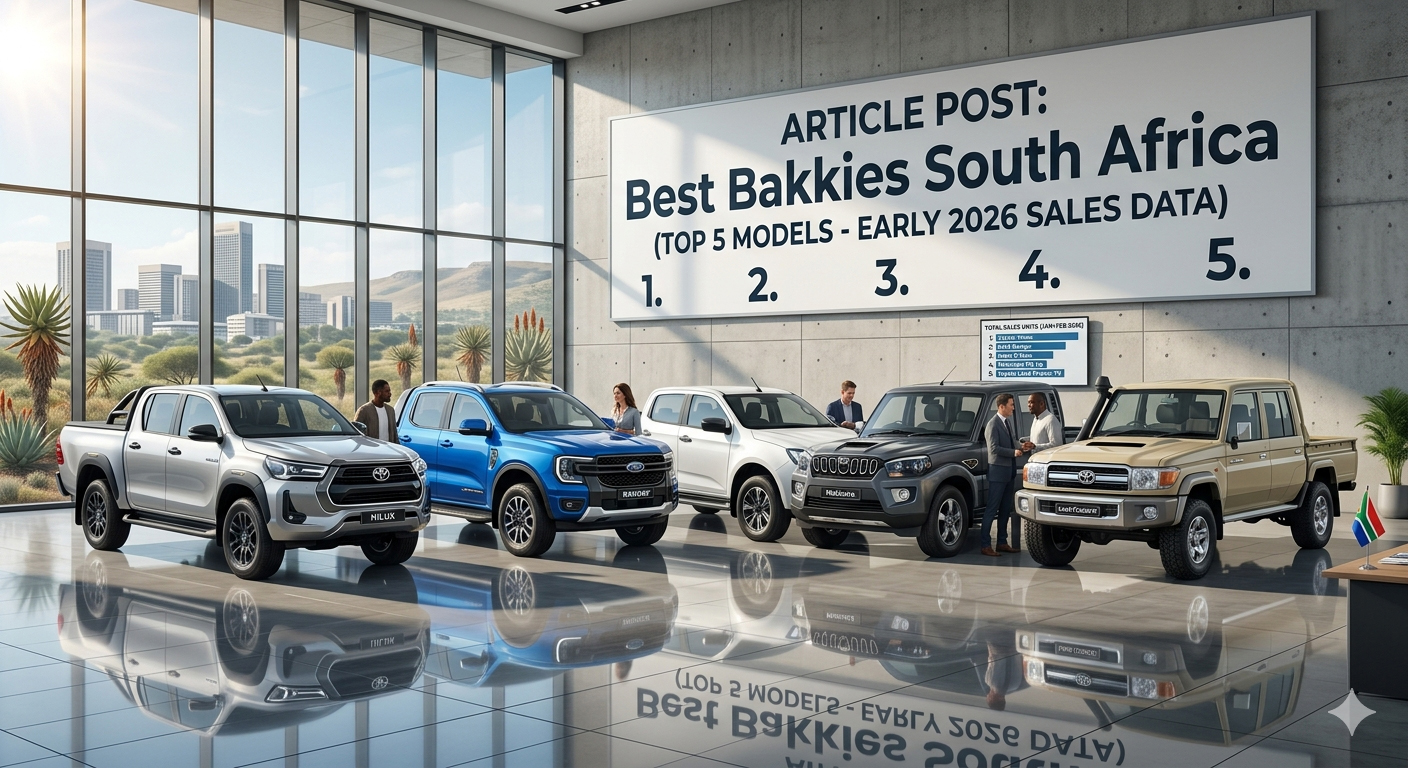
The Ultimate Guide to the Best Bakkies in South Africa (2026)
From the Bush to the Boardroom — What’s Actually Worth Your Money
Let’s be real for a second. In South Africa, the bakkie isn't just a vehicle. It’s a way of life.
Whether you’re a contractor hauling building materials on a Monday, a weekend warrior towing an off-road caravan on a Friday, or a family driver who just loves the commanding view of the road, the double cab has become the king of our streets. But with so many new models flooding the market—from the legendary Toyota Hilux to the latest Chinese contenders—how do you know which one is actually the best?
I’ve dug into the latest sales data, the legal jargon, and the real-world reviews to bring you this complete guide. We’re looking at who is winning the sales race in 2026, which new bakkies are turning heads, and crucially, what the law says you need to drive and load them safely.
Here’s everything you need to know before you sign on the dotted line.
Part 1: The Unquestionable Kings of the Road (The Sales Charts)
If you are looking for popularity as a measure of reliability, the numbers for the first quarter of 2026 tell a fascinating story. There’s a massive shakeup happening at the top, but the old guard is fighting back hard.
The Overall Heavyweights (Q1 2026)
According to Lightstone Auto data, the race is tighter than ever. While the Ford Ranger previously dominated the double-cab segment, the Toyota Hilux is storming back ahead of a major model update.
Rank Model Q1 2026 Sales Figures Key Insight
1 Toyota Hilux 9,955 units The king is back on top, up 22% year-on-year. 2 Isuzu D-Max 6,290 units The "Blesbok" is silently dominating with massive loyalty. 3 Ford Ranger 6,236 units Still the double-cab king (5,140 units), but overall sales slipped. 4 Mahindra Pik Up ~3,200 units The Indian giant has cracked the 4-figure monthly barrier and isn't leaving. 5 GWM P-Series ~1,800 units Leading the Chinese charge with premium features at a lower price.
Why is this happening?
The double-cab segment is specifically led by the Ford Ranger, shifting 5,140 units in Q1. However, the Toyota Hilux absolutely smashes the competition when it comes to Single Cabs (4,333 units) and Extended Cabs (1,361 units), proving that the workhorse market still belongs to Toyota.
My take: You can’t go wrong with the top three (Toyota, Ford, Isuzu). They hold their value like nothing else. But if you want the best "bang for your buck" with a vehicle that has proven its toughness, the Mahindra Pik Up (now locally assembled) is a really smart buy right now.
Part 2: The New Kids on the Block (2026 Models)
The bakkie landscape is changing fast. The days of only having three choices are gone. Here are the most exciting new entrants for 2026.
1. Kia Tasman: The Style King
Kia has finally entered the game, and the Tasman is here. Launched in April 2026, this isn't your grandfather's workhorse. Kia has designed the Tasman to feel like an SUV inside.
-
The Vibe: It has a bold, boxy "mecha" look (love it or hate it) but a stunning interior with dual 12.3-inch screens.
-
The Tech: It comes loaded with safety features like Blind Spot Monitoring and Adaptive Cruise Control.
-
The Reality: It launched mid-Q1, so sales are only starting to trickle in (73 units in March), but it’s one to watch if you want something unique.
2. BYD Shark 6: The Electric Prowler
South Africans love V6 engines, but we are also curious about the future. The BYD Shark 6 is a plug-in hybrid electric vehicle (PHEV) bakkie. It registered 94 units in its first reporting month. It’s still a novelty, but if you want to be the first on your block to plug in your double cab, this is it.
3. JMC Vigus: The Budget Disruptor
JMC (Jiangling Motors Corporation) has relaunched in SA with the all-new Vigus. If your budget is tight, read this.
-
The Price: Starts at R399,900. That is roughly R200k less than a base Hilux.
-
The Spec: You get a 12.8-inch screen, wireless Apple CarPlay, and (on the top model) electronic stability control.
-
The Warranty: 5-year/200,000km warranty.
The Trade-off: Resale value will likely be lower than a Toyota. But if you plan to drive it until the wheels fall off, this is insane value.
Part 3: The Law — What You Need to Drive a Bakkie in SA
Owning a bakkie comes with specific legal responsibilities that don't apply to standard sedans. You can't just assume your Code B licence covers everything.
1. The Licence Trap: Code B vs. Code C1
Most of us have a Code B licence. This allows you to drive a vehicle (and tow a trailer) where the Gross Vehicle Mass (GVM) is up to 3,500kg.
-
The Ford F-250 (the American muscle truck) has a GVM of 3,992kg. Whoops.
-
The Rule: If you buy a massive American bakkie like a Ram 1500 or Ford F-250, you cannot drive it on a Code B. You need a Code C1 licence (and often a Public Drivers Permit).
How to check: Look at the yellow metal plate on the side of the bakkie’s engine bay. If the GVM is over 3,500kg, you need to upgrade your licence.
2. The Loading Law (Regulation 246)
One of the most common mistakes I see on the N1 highway is overloading a bakkie.
The law is crystal clear:
-
Vision is King: You cannot load the vehicle so high that it blocks your view of the road or your side mirrors.
-
Fasten it Down: If the load is not contained within the load body (the bin), it must be securely fastened so that it cannot dislodge, even if you brake hard. A loose ratchet strap is not enough.
-
The "Top-Heavy" Rule: If you put stuff on the roof, the load height cannot exceed half the height of the vehicle from the ground.
Bottom Line: If you lose a couch on the highway because you "thought it was fine," you are criminally liable for the resulting accident.
3. Roadworthiness for Bakkies
Bakkies are classified as Light Motor Vehicles (GVM under 3,500kg) under the National Road Traffic Act.
-
Private Use: You do not need an annual roadworthy certificate (CoR). You only need one when the vehicle changes ownership (you sell it).
-
Business Use (e.g., Construction): If the bakkie is used for reward or business (carrying tools/staff for profit), you technically need a CoR every 12 months.
Part 4: Towing with a Bakkie (The EB Licence Reality)
One of the main reasons people buy a bakkie is to tow a caravan, boat, or horse box. But your standard license might not cut it.
-
The B License Limit: You can tow a trailer up to 750kg GVM.
-
The EB License: If your trailer is heavier than 750kg (which most off-road caravans and boats are), you need an EB (Code EB) license.
The Example: You buy a Toyota Hilux (B license is fine to drive it). You hitch a Metalian Bowhunter trailer (GVM 1,250kg). You need an EB license. Driving without it is a criminal offense, and your insurance might be void in an accident.
Pro Tip: If you have a B license from before a certain year, check the back of your card. Many older licenses automatically included EB, but newer ones (post-1998 usually) require a separate test for EB.
Part 5: Choosing the Best Bakkie for You
With all that legal stuff out of the way, let’s get practical. Here is my cheat sheet for 2026 based on your specific needs.
The Off-Road Overlander: Toyota Hilux / Ford Ranger
You can’t beat these two for aftermarket support. Trailers, rooftop tents, bumpers—everyone makes parts for these. If you plan to go to the Richtersveld, stick to the big two. The Toyota Hilux is getting a 9th generation update in June 2026, so you might get a better deal on the current model, or wait for the snazzy new tech.
The Best Value / Workhorse: Mahindra Pik Up
The numbers don't lie. The Mahindra Pik Up sold over 1,000 units in February 2026. It is rugged, simple, and has a fantastic warranty. If you run a farm or a building site, this saves you tons of cash on the purchase price versus a Hilux.
The Tech Enthusiast / Daily Driver: Isuzu D-Max / GWM P-Series
The Isuzu D-Max is known as the most comfortable cruiser. It eats up highways. The GWM P-Series offers a massive screen and luxury feel for the price of a base-spec Japanese bakkie. If you spend more time on tar (tarmac) than dirt, look here.
The Luxury Statement: Volkswagen Amarok
Based on the Ford Ranger platform but with a plusher interior and German styling. It looks incredible, but you pay a premium for the VW badge (sales are low compared to Ford/Toyota).
Part 6: Quick Reference — Legal Checklist for Bakkie Owners
Before you drive off the lot, save this checklist.
Legal Requirement What the Law Says (South Africa) Reference
Driver's Licence Code B for GVM 3,500kg. Code C1 for "Big Trucks" (F-150/RAM). Towing Code EB required for trailers over 750kg GVM. Load Securing Load must NOT touch the road, block view, or shift. Must be "securely fastened." Roof Load Cannot exceed 50% of vehicle height. Roadworthy (CoR) Not required annually for private bakkies under 3,500kg. Required only on sale.
Final Thoughts
The "best" bakkie in South Africa in 2026 depends entirely on your wallet and your lifestyle.
If you want an investment that will sell easily in 5 years, buy the Toyota Hilux or Ford Ranger. If you want the best value on the market today, test drive the Mahindra Pik Up or look at the JMC Vigus. And if you plan to tow a caravan to Mozambique, spend the extra few hundred rand to upgrade your driver's licence to EB—it will save you thousands in insurance headaches later.
Do your homework, check the GVM plate, and secure your load. Safe driving, South Africa.
Guides
Reviews