 Trailers
 Buses
Buses
 Tractors
 Rollers
 Cranes
 Loaders
 Graders
 Forklifts
 Dozers
 Excavators
 Boats
Boats
 Caravans





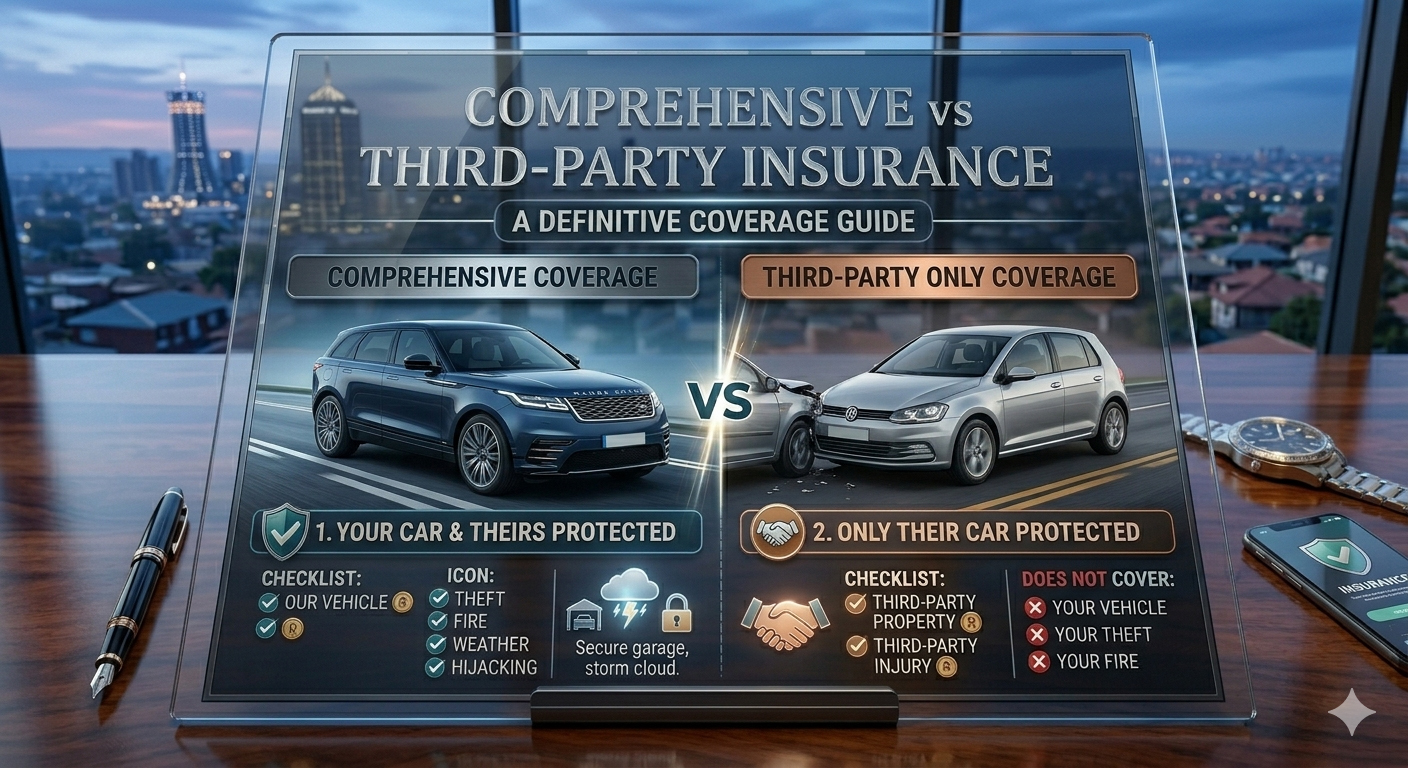
Comprehensive vs Third-Party Insurance in South Africa
Which One Actually Protects You — And Which One Leaves You Exposed?
Let me tell you about two different drivers.
Thabo pays R1,200 a month for comprehensive insurance. He grumbles about it every time the debit order goes off. "Such a waste," he thinks, "I've never even made a claim."
Naledi decided to save money. She pays R250 a month for third-party only cover. "I'm a careful driver," she told herself. "I don't need all that extra stuff."
Then the pothole happened.
Not the little ones you swerve around. The one that hides under a puddle after a thunderstorm in Johannesburg. Thabo hit it at 60km/h. His tyre burst, his rim cracked, and his bumper tore off as the car bottomed out on the broken edge.
R28,000 in damage.
Thabo's comprehensive insurance covered it. He paid his excess of R2,500 and the insurer handled the rest.
Naledi? She hit a different pothole three months later. Same damage. Same R28,000 repair bill. Her third-party insurance paid exactly R0. She had to sell her laptop, borrow from family, and eat into her savings to fix her car.
Same potholes. Very different outcomes.
This guide is going to walk you through exactly what comprehensive and third-party insurance cover, what they don't cover, and most importantly — how to decide which one is right for your situation. Because the cheapest option isn't always the best value, and the most expensive isn't always necessary.
Part 1: The Legal Reality — What South African Law Actually Requires
Before we dive into the comparison, let me clear up a major misconception.
Car insurance is NOT legally required for private vehicles in South Africa . You cannot be arrested or fined simply for driving without insurance.
However, here's the critical exception: if you bought your car with financing from a bank, comprehensive insurance is mandatory . The bank holds the title to the vehicle until you've paid off the loan. They require comprehensive cover to protect their asset. If you let your insurance lapse, the bank will likely force-place expensive cover and add it to your monthly payment.
What about the Road Accident Fund (RAF)? Every driver contributes to the RAF through the fuel levy . The RAF provides compensation for personal injury caused by motor vehicle accidents, regardless of who was at fault.
But here's what the RAF does NOT cover:
-
Damage to your vehicle
-
Damage to someone else's vehicle
-
Damage to property (buildings, fences, walls)
-
Any economic losses
Your car's bodywork is entirely your responsibility
Part 2: The Three Types of Car Insurance Explained
Let me break down your options clearly. Insurers in South Africa generally offer three distinct levels of cover .
Third-Party Only — The Bare Minimum
What it covers:
-
Damage you cause to another person's vehicle
-
Damage you cause to someone else's property (walls, fences, buildings)
-
Injury to other people (though the RAF also covers this)
What it does NOT cover:
-
Any damage to YOUR vehicle whatsoever
-
Theft of your vehicle
-
Fire damage
-
Vandalism
-
Weather damage (hail, floods, storms)
What it typically costs: Between R70 and R550 per month, depending on your vehicle and risk profile .
Who it's for: This is the cheapest option, but it leaves you completely exposed. If you drive an old car worth R30,000 and you're willing to walk away from it if something happens, third-party might make sense. For most other drivers, the savings aren't worth the risk.
A real-world example: A driver with third-party only cover causes an accident. Their insurer pays for the other car's repairs. The driver pays for their own car's repairs out of pocket — potentially tens of thousands of rands .
Third-Party, Fire and Theft — The Middle Ground
What it covers:
-
Everything third-party covers
-
Loss of your vehicle due to theft or hijacking
-
Fire damage to your vehicle (including electrical fires)
What it does NOT cover:
-
Damage to YOUR vehicle from an accident (unless the accident was caused by fire or you were hijacked)
-
Vandalism or attempted theft (unless it results in fire)
What it typically costs: Between R350 and R700 per month .
Who it's for: This is a genuine middle-ground option. Older cars often have electrical problems that can cause fires. Theft is a major concern in South Africa. If your car isn't worth full comprehensive but you still want protection against total loss from theft or fire, this could work.
Comprehensive Cover — The Full Package
What it covers:
-
Everything from third-party, fire, and theft
-
Accident damage to YOUR vehicle, regardless of who is at fault
-
Vandalism and attempted theft damage
-
Weather damage (hail, floods, storms)
-
Usually includes windscreen cover (some insurers offer zero excess on glass claims)
-
Often includes roadside assistance and towing
-
Some policies include car hire while yours is being repaired
What it typically does NOT cover:
-
Normal wear and tear
-
Mechanical breakdowns (that's what maintenance plans are for)
-
Damage from driving under the influence
-
Driving with a suspended or invalid licence
-
Commercial use if you have a domestic policy
-
Damage caused by an unroadworthy vehicle (more on this in Part 5)
What it typically costs: Between R800 and R2,500+ per month . Averages vary significantly by vehicle value and location. For a vehicle valued between R200,000 and R450,000, expect to pay roughly R700–R1,400 per month .
Who it's for: Most financed cars require comprehensive cover. If your car has significant value (more than R80,000–R100,000), comprehensive is usually worth the extra cost. The peace of mind alone is valuable.
Part 3: Head-to-Head Comparison
Let me put this in a clear table so you can see the differences at a glance.
Feature Third-Party Only Third-Party + Fire/Theft Comprehensive
Damage to other people's cars ✓ ✓ ✓ Damage to property (walls, fences) ✓ ✓ ✓ Theft of your car ✗ ✓ ✓ Fire damage to your car ✗ ✓ ✓ Accident damage to YOUR car ✗ ✗ ✓ Vandalism ✗ ✗ ✓ Hail, flood, storm damage ✗ ✗ ✓ Windscreen cover ✗ ✗ Often included Roadside assistance ✗ ✗ Often included Car hire while yours is repaired ✗ ✗ Sometimes included Monthly premium range R70 – R550 R350 – R700 R800 – R2,500+ Best for Very low-value cars Medium-value cars in high-theft areas Financed or valuable cars
[Data sources: 1, 3, 6, 9]
Part 4: The Real Cost of Being Underinsured
Let me show you some concrete numbers based on current market pricing.
Cheapest comprehensive entry points in South Africa (2026-2027):
Insurer Starting Comprehensive Premium Key Feature
Prime (formerly PMD) ~R409/month 24-month fixed premium guarantee OUTsurance Essential ~R350/month Only for cars 5 years old, value under R125k King Price ~R500/month Premium decreases monthly with depreciation Budget Insurance ~R550/month 7 tiered products to choose from Naked ~R700/month (or R70 TPO) CoverPause — pay 50% when car is parked
[Data source: 1]
Now, let's do the real-world comparison.
You own a car worth R150,000. You have three options:
Cover Type Monthly Premium Annual Cost What Happens If You're In An Accident
Third-Party Only R150 R1,800 You pay for ALL your own repairs (+R20k to R80k) Third-Party + Fire/Theft R450 R5,400 You pay for your accident repairs, but theft/fire covered Comprehensive R850 R10,200 Your R45,000 repair bill costs only your excess (~R2,500-R5,000)
The difference between third-party only and comprehensive is R8,400 per year in premiums. A single moderate accident costing R45,000 in repairs wipes out five years of premium savings instantly.
Part 5: The Roadworthiness Trap — Why Your Claim Could Be Rejected
This section might save you tens of thousands of rands. Read carefully.
Your insurance policy includes a condition that your vehicle must be roadworthy at all times. If your car's poor condition causes or contributes to an accident, your insurer can legally reject your claim .
Edite Teixeira-Mckinon, Lead Ombud of the Non-life Insurance Division of the National Financial Ombud Scheme (NFO), explains:
"Generally, insurance companies provide cover on the condition that the insured party takes reasonable steps to prevent harm. Most policies explicitly state that claims may be denied if the insured fails to comply with the National Road Traffic Act and the vehicle is not roadworthy at the time of the incident" .
The Most Common Reasons Claims Are Rejected
Two issues top the list:
-
Worn tyres — tread depth below the legal minimum of 1.6mm
-
Faulty brakes — worn pads, leaking lines, or uneven braking
Real Case Study from the NFO
A driver lost control of his vehicle while driving through a puddle of water. He claimed for accident damage. The insurer's expert found that the left rear tyre was unroadworthy — the tread wear indicators were level with the remaining tread pattern.
The expert concluded that the worn tyre could not disperse the water that the front tyres were channeling toward the rear. The car aquaplaned, and the driver lost control .
The outcome: The claim was rejected, and the NFO upheld the rejection. The unroadworthy tyre was the proximate cause of the accident.
The Critical Legal Distinction
For an insurer to reject your claim based on unroadworthiness, they must prove that the defect caused or contributed to the accident . It's not enough to simply point out that your car has issues.
In another case, a driver swerved to avoid a pothole and his vehicle fell onto its side. The insurer rejected the claim, citing worn brake shoes and a worn rear brake disc. The NFO overturned the rejection because the driver never applied the brakes during the incident — the insurer could not prove that the brake condition was material to how the accident happened .
This Affects All Cover Types Equally
This roadworthiness requirement applies regardless of which insurance type you have. Whether you have comprehensive or third-party only, if your unroadworthy vehicle causes an accident, your insurer can reject your claim. For third-party only drivers, this is doubly dangerous — not only are you paying for your own repairs, but you might also be personally liable for the other driver's damages.
Part 6: What About Liability Limits?
This is an important detail that many policyholders miss.
Third-party liability coverage has a maximum limit. For example, Pineapple's comprehensive car insurance pays a maximum of up to R5 million for third-party incidents .
What does this mean? If you cause an accident that results in damages exceeding that limit — say you crash into a luxury car worth R2 million and also damage commercial property — you could be personally liable for the excess above your policy limit.
For most drivers, R5 million is more than sufficient. But if you regularly drive in areas with high-value vehicles, or if your profession puts you at risk of being sued personally for damages, it's worth checking your policy's liability limit.
Part 7: How to Choose What's Right for You
Not everyone needs comprehensive cover. Not everyone should settle for third-party only. Here's how to decide.
Choose Third-Party Only If:
Condition Why
Your car is worth less than R50,000 The annual comprehensive premium might exceed the car's value You could afford to replace the car tomorrow If the car is written off, you won't face financial hardship You rarely drive (under 5,000 km/year) Lower accident exposure reduces your risk The car is parked securely at all times Theft risk is lower
Choose Third-Party + Fire/Theft If:
Condition Why
Your car is worth R50,000 – R100,000 Comprehensive might be overkill, but theft/fire protection is valuable You park in a high-theft area Theft is a real risk The car has known electrical issues Fire risk from wiring problems You can afford accident repairs out of pocket You're self-insuring for collision damage
Choose Comprehensive If:
Condition Why
Your car is financed The bank requires it Your car is worth more than R100,000 Accident damage could be financially devastating You couldn't afford to replace the car tomorrow This is the real test — if losing the car would be a crisis, get comprehensive You drive frequently (over 15,000 km/year) Higher accident exposure You want peace of mind Knowing you're fully protected has value beyond the numbers
Part 8: The Bank's Requirement
If you're financing your car through a bank, you don't have a choice in the matter. The bank will require comprehensive insurance as a condition of the loan .
What happens if you let your comprehensive cover lapse?
-
The bank will be notified
-
The bank may force-place their own insurance on the vehicle
-
Force-placed insurance is typically more expensive than what you could buy yourself
-
The cost will be added to your monthly loan payment
Bottom line: If you have a car loan, keep your comprehensive insurance active.
Part 9: Frequently Asked Questions
Is third-party insurance worth it for a cheap car?
Maybe. If your car is worth less than R50,000, the annual comprehensive premium might be a significant percentage of the car's value. However, consider the liability risk. Even with third-party only, if you cause an accident, your insurer will pay for the other vehicle's damage — but if your car's unroadworthy condition contributed to the accident, your claim could be rejected entirely .
Does comprehensive cover everything?
No. Comprehensive is the most extensive cover available, but it still has exclusions. Standard exclusions include normal wear and tear, mechanical breakdowns, damage from driving under the influence, and damage caused by an unroadworthy vehicle .
What's the cheapest comprehensive insurance in South Africa?
Based on current market data, Prime (formerly PMD) offers comprehensive cover starting from approximately R409 per month, and OUTsurance Essential starts from around R350 per month for eligible vehicles (older than 5 years, value under R125,000, fully paid off) .
Can I switch from third-party to comprehensive?
Yes, at any time. Contact your insurer or a broker. Expect your premium to increase significantly, but your protection will increase even more.
What happens if an uninsured driver hits me?
If you have comprehensive insurance, your insurer will cover your repairs and then pursue the at-fault driver for recovery. If you only have third-party cover, you are responsible for your own repairs and must sue the other driver directly — which is often impossible if they have no assets.
Part 10: Quick Reference Summary
Your Situation Recommended Cover Typical Monthly Cost
Car worth under R50k, paid off, parked securely Third-Party Only R70 – R250 Car worth R50k–R100k, paid off, theft risk present Third-Party + Fire/Theft R350 – R550 Car worth over R100k, financed or not Comprehensive R600 – R1,400+ Any car, any value, if financed Comprehensive (required) Varies
Final Thoughts
Here's what I want you to remember.
Third-party insurance is cheap. Really cheap. But it leaves you completely exposed if something happens to your car. One pothole, one hailstorm, one stolen vehicle, and you're paying for everything yourself.
Comprehensive insurance costs more. Sometimes significantly more. But it protects you from almost everything — accidents, theft, fire, weather, vandalism. When the unexpected happens, you pay your excess and the insurer handles the rest.
The roadworthiness trap applies to both. Keep your tyres and brakes in good condition, or your insurer can reject your claim regardless of which cover type you have .
If your car is financed, you don't have a choice — comprehensive is required.
If your car is paid off, you have a choice to make. Ask yourself this question: Could I afford to replace this car tomorrow if it was stolen or written off? If the answer is no, you need comprehensive cover.
Because the cheapest insurance isn't the one with the lowest monthly premium. It's the one that actually pays when you need it.
References
-
Uni24.co.za. "Cheapest Car Insurance In South Africa (2026-2027): Best Budget Options And How To Pay Less." (April 2026)
-
National Financial Ombud Scheme (NFOSA). "Why Your Vehicle's Unroadworthiness Could Cost You Your Insurance Cover." (October 2025)
-
MiWay Insurance. "Know Your Car Insurance Rights." (January 2025)
-
Makoya Learning. "How to Choose the Best Car Insurance in South Africa: A Practical Guide for Drivers." (March 2026)
-
Pineapple. "Extra! Extra! Read All About Liability Car Insurance." (January 2024)
-
Uni24.co.za. "Santam Car Insurance Review (2026-2027): Benefits, Costs, Claims Experience And Is It Worth It." (April 2026)
Guides
Reviews