 Trailers
 Buses
Buses
 Tractors
 Rollers
 Cranes
 Loaders
 Graders
 Forklifts
 Dozers
 Excavators
 Boats
Boats
 Caravans





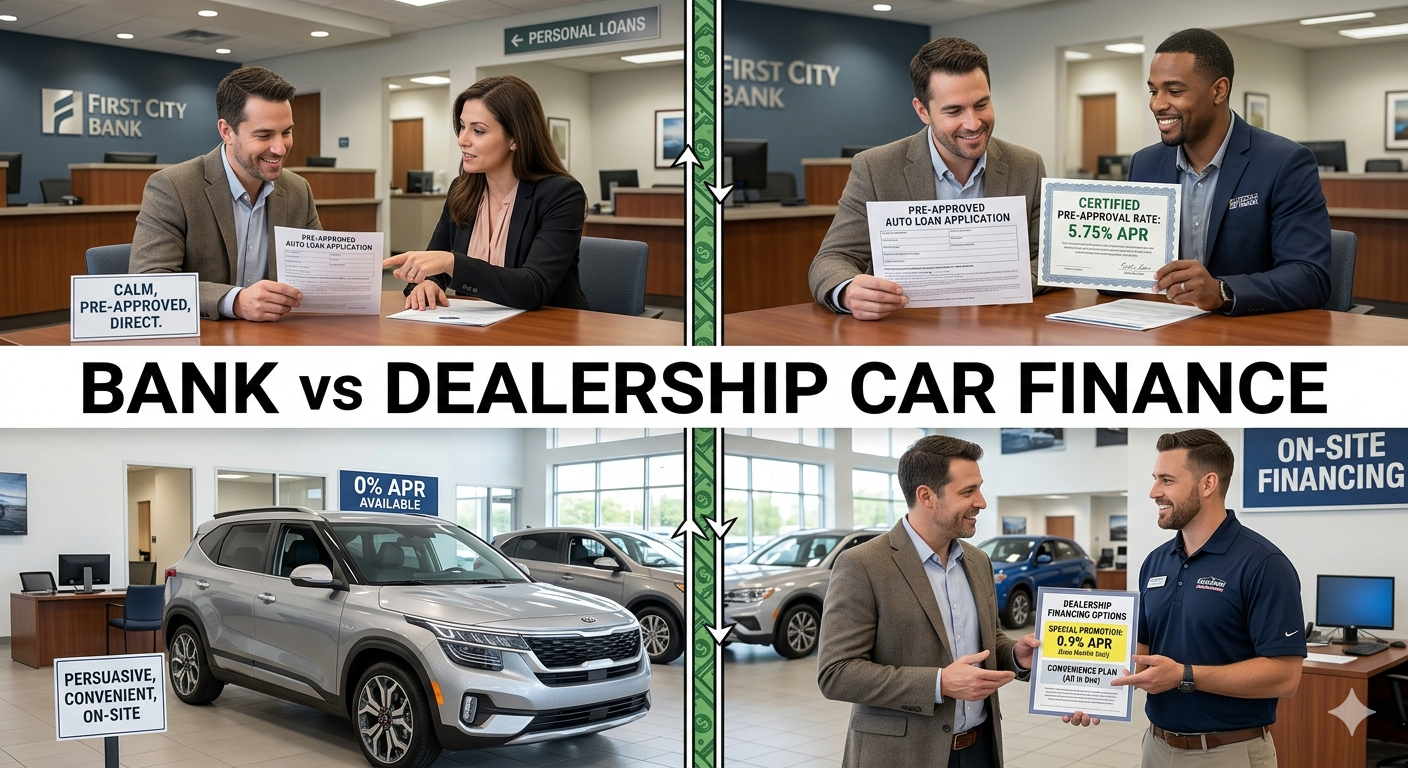
Bank vs Dealership Car Finance in South Africa
Which Option Puts More Money Back in Your Pocket?
Let me tell you about two friends of mine.
Thabo walked into a dealership, saw his dream car, and let the finance manager handle everything. Twenty minutes later, he drove away with a new set of keys and a monthly payment he could almost afford.
Naledi did things differently. Before she even set foot in a dealership, she got pre-approved by her bank. She knew exactly what she could spend. When the finance manager tried to upsell her on a longer loan term with a lower monthly payment, she smiled, declined, and negotiated a better price on the car instead.
Same car. Same year. Similar credit profiles. Naledi saved over R40,000 in interest over five years.
The difference wasn't luck. It was understanding how car finance works in South Africa – and knowing that where you get your finance can be just as important as what car you buy.
Let me walk you through everything you need to know about bank versus dealership car finance, including what the law says about protecting you in either scenario.
Part 1: The Two Paths to Car Finance Explained
Before we dive into which is better, let me clearly explain how each option actually works.
What Is Pre-Approved Bank Finance?
In this scenario, you go directly to a bank – WesBank, ABSA, FNB, Standard Bank, or Nedbank – and apply for a vehicle loan before you start shopping for a car.
The bank reviews your credit history, income, and existing debts. If approved, they give you a pre-approved amount – a clear ceiling on what you can spend. You can then shop for a car knowing exactly what you're working with.
Key features of bank finance:
-
You apply directly, without a dealership intermediary
-
You receive pre-approval before car shopping
-
The loan amount is based entirely on your creditworthiness
-
You have full control over the application process
What Is Dealer-Arranged Finance?
This is what most South Africans choose – and I understand why. It's convenient.
When you buy a car from a dealership, they have a Finance and Insurance (F&I) manager whose job is to handle the financing for you. This person acts as a concierge between you and multiple banks.
Here's how Brandon Cohen, Chairperson of the National Automobile Dealers' Association (NADA), explains it:
"The modern automotive dealership is a hub of financial expertise, where experienced F&I professionals navigate a wide range of options available to car buyers, including non-traditional models such as rent-to-own, subscriptions, and lease agreements, to ensure most clients find a structure that suits their lifestyle and budget".
Key features of dealer finance:
-
The F&I manager submits your application to multiple banks at once
-
They can pull quotes simultaneously, allowing easy comparison
-
The dealer handles all paperwork
-
You can often get approved and drive away the same day
Part 2: The Head-to-Head Comparison
Let me break down the pros and cons of each option so you can see clearly which might work better for your situation.
Bank Finance: The Pros
Pro Why It Matters
You control the process You decide how much to borrow, not the dealer No sales pressure You're not sitting across from someone who profits when you finance more Better negotiation position You walk in as a cash buyer (more on this later) Lower risk of upsells The bank won't push you toward balloon payments you don't need Transparency Every fee is disclosed upfront in the bank's terms
Brandon Cohen notes that pre-approved bank finance "provides the peace of mind that comes with knowing the precise spending allowance, eliminating the risk of a finance application being declined at the point of sale".
Bank Finance: The Cons
Con Why It Matters
Time-consuming You need to approach multiple banks or research their rates Requires financial literacy First-time buyers may find it daunting Potentialy missing better rates Cohen says most buyers "may find it taxing to approach multiple institutions individually to compare offers, potentially missing out on more competitive rates"
Dealer Finance: The Pros
Pro Why It Matters
Convenience One stop – choose the car and finance in the same place Access to multiple banks The F&I manager applies to several lenders at once Expert guidance F&I professionals understand different deal structures Tailored to your budget Deals can be structured around what you can afford Faster approval Often same-day, sometimes same-hour
"The added benefit of dealer finance is that deals can be tailored to most budgets," Cohen explains.
Dealer Finance: The Cons
Con Why It Matters
Conflict of interest The dealer earns commission when you finance Less control over the deal The F&I manager, not you, shops for rates Potential for unnecessary extras You might be sold credit life insurance, warranties, or balloon payments you don't need Risk of payment shock Dealers can "make the numbers work" by extending the loan term, hiding the true cost
Part 3: The Industry Secret – Why Dealers Want You to Finance
Here's something most car buyers never learn.
Dealerships earn a Dealer Incentive Commission (DIC) from banks for every finance deal they sign. This is a payment from the bank to the dealer for bringing them business.
What does this mean for you?
-
Financed buyers are more valuable to dealers than cash buyers
-
Some dealers are less willing to discount the car's price if you pay cash because they lose that bank commission
-
The F&I manager's salary often depends on selling finance and extras
This doesn't mean dealer finance is bad. But you should understand the incentives at play.
A clever strategy some savvy buyers use:
Finance the car through the dealer to get a better out-the-door price or free extras (like a maintenance plan or roof rack), then pay off the entire loan within the first month to minimise interest. The dealer still pays the commission (they won't be happy), but you get the benefit.
Part 4: The Legal Framework – What the Law Says
Understanding your legal rights is crucial regardless of which finance route you choose. A landmark 2025 Supreme Court of Appeal decision fundamentally changed how car finance transparency works in South Africa.
The OTR Fees Landmark Case (September 2025)
The case of National Credit Regulator v National Consumer Tribunal and Others reached the Supreme Court of Appeal after years of legal battles between the NCR and major vehicle financiers BMW, Volkswagen, and Mercedes-Benz.
What was the dispute about?
The National Credit Regulator (NCR) argued that "on-the-road" (OTR) fees – costs like pre-delivery inspections, roadworthy certificates, licensing, registration, number plates, and fuel – should not be financed as part of the loan. They claimed these fees violated sections 100, 101, and 102 of the National Credit Act.
The financiers argued they didn't charge these fees – they simply financed a purchase price that the dealer and consumer had already agreed upon.
What the SCA decided:
The court dismissed the NCR's appeal, meaning OTR fees can be financed. BUT – and this is a big "but" – the court imposed strict transparency requirements for all future transactions.
Judge Tati Makgoka, writing for the SCA, made a powerful point about why transparency matters:
He gave an example of a car wash costing R100. "Financed as part of the deferred amount at 8% over 72 months, the consumer would end up paying R676 under the credit agreement. This figure would climb even higher at the current interest rate of 10.50%, totalling R703.60 over 72 months. There is no indication in the documentation before us that consumers have been made aware of this fact".
That R100 car wash costs R703 when financed over six years. Now imagine that same mathematics applied to R5,000 in OTR fees.
The Three Transparency Requirements
The SCA established three rules that apply to every financed vehicle purchase, whether through a bank directly or a dealer:
1. Individual specification of OTR items
Any OTR items added to the purchase price must be individually specified. The credit provider must clearly state the nature and cost of each item.
You should see a line-by-line breakdown, not a lump sum "OTR fees" entry.
2. Consumer choice – cash or finance
Consumers must be explicitly asked whether they wish to pay cash for these items or finance them as part of the principal debt.
This is your right. Exercise it.
3. Informed financial decision
To ensure an informed choice, consumers must be shown the difference between the cash price of the items and the total cost (including interest) if financed.
If the dealer or F&I manager can't or won't show you this, that's a red flag.
What the Law Says About Principal Debt
Under the National Credit Act, the "principal debt" in an instalment sale agreement includes:
-
The tax invoice amount or loan amount (vehicle price minus deposit or trade-in)
-
An initiation fee (unless paid upfront)
-
Section 102 fees: extended warranty costs, delivery and initial fuelling charges, licence and registration fees, credit insurance premiums
The SCA made it clear that section 102(1) contains a closed list. Credit providers cannot add similar charges under a general line item like "service charge" or "administration fee".
"In each case, any extra charge should be examined to determine whether it can be regarded as forming part of the purchase price, regardless of the name given to it in the credit agreement. It is the nature of the charge that is essential, not how it is named".
Your Rights Under the National Credit Act
When you finance a car – whether through a bank directly or a dealer – the NCA gives you these protections:
Right What It Means
Full disclosure All costs must be disclosed before you sign Transparency of fees Every fee must be identified and explained Total cost of credit The full rand amount you will repay must be shown Right to choose You can pay OTR fees in cash rather than finance them Right to shop around You are not locked into dealer financing In duplum protection Unpaid interest cannot exceed the outstanding capital
Part 5: Which is Cheaper? The Numbers Don't Lie
Let me give you a concrete comparison.
The Cost of Finance
According to AutoTrader data, the average price of a car sold in South Africa in 2026 is around R420,000. Very few people have that kind of cash available.
Here's what financing looks like:
Car Price Finance Term Typical Rate Total Interest Total Cost
R350,000 72 months Prime + 2% (~12.25%) ~R150,000 ~R500,000+
That's the difference – R150,000 extra – just for financing.
The "Cash is King" Myth
Here's the twist. Despite cash being mathematically cheaper, dealers often prefer you to finance because of that Dealer Incentive Commission.
This creates a strange dynamic:
-
Pay cash: Lower total cost, but dealers may discount the car less
-
Finance: Higher total cost, but dealers may offer a better price or free extras
The loophole: Finance the car to get the discount and extras, then pay off the loan within the first month. You get the best of both worlds – the dealer's incentives plus minimal interest.
Balloon Payments – A Warning
Be very careful with dealership finance that advertises suspiciously low monthly payments. These usually include a balloon payment – a large lump sum due at the end of the term, often 30-40% of the car's value.
Why this matters: While the monthly cost is lower, the total interest paid is much higher because you are paying interest on that large balloon amount for the entire duration of the loan.
Part 6: Step-by-Step Guide to Each Option
How to Get Pre-Approved Bank Finance
Step 1: Check your credit score using TransUnion, Experian, or Compuscan.
Step 2: Approach your bank (the one where you have your salary account is often easiest).
Step 3: Submit the required documents: ID, 3 months' payslips, 3 months' bank statements, proof of address.
Step 4: Receive your pre-approved amount. This is not a final approval on a specific car, but it tells you your ceiling.
Step 5: Shop for a car within that approved amount.
Step 6: Once you choose a car, the bank does a final approval based on the specific vehicle's value.
Useful tool: WesBank offers a FastApp that requires only five data fields to get pre-approval in minutes.
How Dealer-Arranged Finance Works
Step 1: Choose your car at the dealership.
Step 2: Meet with the F&I manager and provide your documents (same as above).
Step 3: The F&I manager submits your application to multiple banks simultaneously.
Step 4: You receive offers from different lenders and choose the best rate and terms.
Step 5: Sign the finance agreement at the dealership.
Step 6: Drive away – often the same day.
Part 7: Five Red Flags to Watch For
No matter which route you choose, watch out for these warning signs.
Red Flag 1: "We can get anyone approved"
No legitimate lender guarantees approval without checking your credit history. This line usually means high interest rates or questionable lending practices.
Red Flag 2: Pressure to sign quickly
Legitimate lenders and dealers want you to understand what you're signing. If someone is rushing you, especially about the OTR fee breakdown, walk away.
Red Flag 3: OTR fees lumped into one line item
Under the SCA ruling, every OTR fee must be individually specified with its nature and cost. If the F&I manager can't or won't break it down, that's a violation of the law.
Red Flag 4: No comparison between cash and financed OTR costs
You have the legal right to see the difference between paying OTR fees in cash versus financing them. If they refuse to show you this comparison, something is wrong.
Red Flag 5: Balloon payments you don't fully understand
If the monthly payment looks too good to be true, there's probably a balloon payment at the end. Make sure you understand exactly how much you'll owe and how you'll pay it.
Part 8: Which Should You Choose?
Let me give you clear guidance based on your situation.
Choose Pre-Approved Bank Finance If:
Your Situation Why
You have good credit You'll likely qualify for the best rates You want full control You decide the terms, not the dealer You have time The process takes longer but saves money You're a first-time buyer You avoid F&I pressure tactics You want the lowest total cost Bank direct often beats dealer-marked rates
Choose Dealer-Arranged Finance If:
Your Situation Why
You value convenience One-stop shopping saves time You have complex finances F&I managers can work with unusual situations You're unsure about rates They can pull quotes from multiple banks instantly You want access to special deals Manufacturers sometimes offer promotional finance rates You're considering balloon or GFV structures F&I managers specialise in these complex products
The Hybrid Approach (My Personal Recommendation)
Get pre-approved by your bank before going to the dealership. This gives you a baseline. Then, when the F&I manager presents their offers, you can compare them against what you already know you qualify for.
If the dealer beats your bank's rate? Great – finance through them and the dealer wins. If not, you have your pre-approval ready.
Either way, you hold the power, not the dealer.
Part 9: Quick Reference Comparison Table
Feature Bank Finance Dealer Finance
Who submits the application You Dealer F&I manager When you apply Before car shopping At the dealership Access to multiple lenders You must approach each F&I manager does it for you Level of control High – you set the terms Lower – dealer intermediates Convenience Requires separate steps One-stop shopping Time to approval Days to a week Often same-day Risk of upsells Low Higher (warranties, insurance, GAP cover) Dealer commission influence None Yes – DIC affects dealer behaviour Best for Informed buyers, good credit, time to plan Convenience seekers, complex situations Your legal rights Full NCA protection Full NCA protection
Part 10: Frequently Asked Questions
Can I switch from dealer finance to bank finance after signing?
Generally, no. Once you've signed the finance agreement, you're committed. However, you can refinance with your bank later, though this may involve early settlement penalties.
Is the interest rate different between bank and dealer finance?
The bank ultimately sets the rate regardless of how you apply. However, dealers may add a margin to the bank's rate as their commission. This is why pre-approval is valuable – you know the "clean" rate before dealer markups.
Do I have to use the dealer's F&I manager?
No. You are never legally required to finance through the dealership. You can walk in with your own pre-approval and the dealer must accept it.
What's the best way to compare offers?
Ask for the total cost of credit (the full rand amount you will repay over the entire loan term). Compare that number, not just the monthly payment.
Can I pay cash for OTR fees even if I finance the car?
Yes. Under the SCA ruling, you have the right to choose whether to pay OTR fees in cash or finance them. Exercise this right.
Final Thoughts: Knowledge Is Your Best Leverage
Here's what I want you to remember.
Both bank and dealer finance can get you into a car. But the difference in how you approach the process can save – or cost – you tens of thousands of rands.
The law is on your side. The NCA requires transparency. The SCA's OTR ruling gives you the right to see exactly what you're paying for and choose whether to finance those costs.
But the law only protects you if you know your rights.
Here's my advice:
-
Get pre-approved by your bank first. Even if you don't use it, you have a baseline for comparison.
-
Ask the F&I manager for the total cost of credit in rands. Not the monthly payment. The full number.
-
Request the OTR fee breakdown. The law requires individual specification.
-
Compare paying OTR fees in cash vs financing them. The dealer must show you this difference.
-
Don't be rushed. Legitimate deals don't expire in an hour.
The best car deal isn't the one with the lowest monthly payment. It's the one where you understand every number on that contract – and you walk away knowing you paid a fair price for both the car and the money you borrowed to buy it.
Guides








Reviews