 Trailers
 Buses
Buses
 Tractors
 Rollers
 Cranes
 Loaders
 Graders
 Forklifts
 Dozers
 Excavators
 Boats
Boats
 Caravans





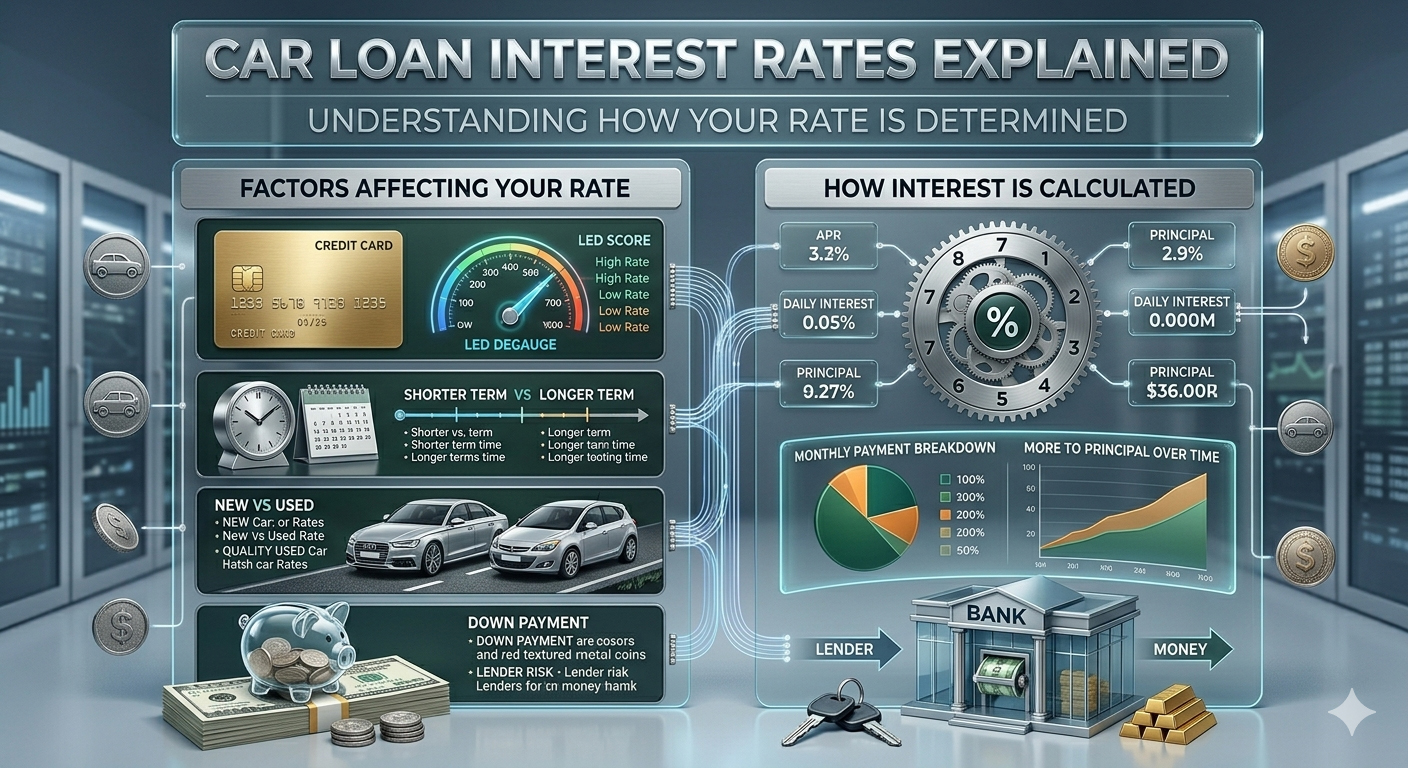
A Complete Guide to How Interest Works, What You'll Pay, and Your Legal Rights
Let me be honest with you.
When you walk into a car dealership or sit down to apply for vehicle finance, the number everyone focuses on is the monthly instalment. Can I afford R4,500 per month? Great, let's sign.
But here's what nobody explains to you: that monthly number is hiding a much bigger story. The interest rate attached to your car loan determines whether you pay back R250,000 or R350,000 for a car that cost R200,000. And most people don't understand how interest works until they're already locked into a five-year contract.
This guide is going to change that. I'll walk you through exactly how car loan interest works in South Africa, what rates you can expect, how the law protects you from predatory lending, and most importantly – how to make sure you're getting a fair deal.
Part 1: What Is Interest, Really?
Let's start with the basics.
When a bank lends you money to buy a car, they're not doing it out of kindness. They're a business, and their product is money. The interest rate is simply the price you pay for borrowing that money.
Think of it this way: you're renting the bank's money for a period of time. The interest is your rent payment.
Here's how WesBank, one of South Africa's largest vehicle finance providers, explains it:
"Whenever you pay a person or company back with more than you originally borrowed from them, you are paying some form of interest. In formal credit (such as vehicle finance), interest is normally charged over time, as a percentage of the amount owing. This is known as the interest rate. The longer you have an outstanding balance with your finance provider, the more interest you'll end up paying" .
That last sentence is crucial. Time is the enemy when it comes to interest. A 72-month loan (six years) will cost you significantly more in interest than a 54-month loan, even if the interest rate is exactly the same.
Part 2: The Legal Maximum – What the National Credit Act Says
Here's something every borrower should know: there is a legal maximum interest rate that lenders can charge you.
Under the National Credit Act (NCA), the maximum interest rate on a new vehicle finance contract is the national repo rate plus 17% .
As of early 2026, with the repo rate at 6.75%, this works out to a maximum of 24.75% .
Now, before you panic – you will almost never pay this rate from a reputable lender. This cap exists to prevent predatory lending. It's the absolute ceiling, not the typical rate.
The Credit Association of South Africa has noted that the NCA's rates and fees framework hasn't been reviewed in 11 years, and more than 70% of consumers are being declined for formal credit and pushed into the informal lending market . That's a serious problem, but for car finance from major banks, you're operating within a regulated, transparent framework.
What This Means for You
Rate Type Typical Range Who Gets This Prime-linked (9.75% – 11.25%) Best available Excellent credit, large deposit, short term Average (12% – 16%) Most common Good credit, standard deal High (17% – 24.75%) Subprime Poor credit history, high risk profile Maximum (24.75%) Rare Only if you have terrible credit AND an predatory lender
The good news: with an average credit rating at a respectable finance institution, you're more likely to receive an interest rate somewhere between prime and 15.30% .
Part 3: Prime Rate – The Number That Moves Everything
You've seen the term "prime rate" in the news. But what does it actually mean for your car loan?
The prime lending rate is the benchmark interest rate that commercial banks use as their base for lending to customers. It's directly linked to the repo rate – the rate at which the South African Reserve Bank (SARB) lends money to commercial banks.
When the SARB changes the repo rate, banks almost immediately adjust their prime rate accordingly.
The Current Situation (March 2026)
As of March 2026, the SARB has held the repo rate at 6.75%, with the prime lending rate at 10.25% .
Here's how we got here:
Date Action Repo Rate Prime Rate March 2024 Held 8.25% 11.75% September 2024 Cut 25bp 8.00% 11.50% November 2024 Cut 25bp 7.75% 11.25% January 2025 Cut 25bp 7.50% 11.00% May 2025 Cut 25bp 7.25% 10.75% July 2025 Cut 25bp 7.00% 10.50% November 2025 Cut 25bp 6.75% 10.25% January 2026 Held 6.75% 10.25% March 2026 Held 6.75% 10.25%
What this means for you: The repo rate has fallen 150 basis points from its 2024 peak. If you have a variable interest rate loan (linked to prime), your monthly payments have likely decreased over the past 18 months. If you have a fixed rate, your payments stay the same regardless of what the SARB does.
Prime Rate and Your Car Loan
Most car finance agreements in South Africa are linked to the prime rate. This means your interest rate is expressed as "prime minus X%" or "prime plus X%".
-
Prime minus 1% = 9.25% (if prime is 10.25%) – Excellent credit
-
Prime = 10.25% – Good credit
-
Prime plus 2% = 12.25% – Average credit
-
Prime plus 5% = 15.25% – Poor credit
Here's what Absa, one of South Africa's largest banks, explains about variable vs fixed rates:
"If the interest rate on your principal debt is variable, it will change as your credit provider's reference rate changes. This is also known as the prime rate. A credit provider will let you know if there are changes in its prime rate and if there are any adjustments to your instalment amount due to the rate change.
If the interest rate on your principal debt is fixed, the interest rate will stay unchanged for the full term of your instalment sale agreement, regardless of whether the prime rate is adjusted up or down" .
Fixed rates give you certainty – your payment never changes. Variable rates can save you money when rates drop, but cost you more when rates rise.
Part 4: What Determines YOUR Interest Rate?
Not everyone gets the same rate. Here's what banks look at when deciding what to charge you.
1. Your Credit Score (The Biggest Factor)
Your credit score is the single most important determinant of your interest rate. It's a number that summarizes your history of borrowing and repaying money.
Higher credit score = Lower risk = Lower interest rate
If you've paid your accounts and loans on time, you'll likely qualify for a rate near prime or even below prime. If you've missed payments or defaulted, expect to pay more – potentially significantly more.
2. Your Deposit
Putting money down reduces the amount you need to borrow. This lowers the bank's risk, which can improve your interest rate.
3. The Loan Term
Longer loan terms (72 or 84 months) generally come with higher interest rates because you're tying up the bank's money for longer.
4. The Car Itself
Banks prefer newer vehicles because they retain value better. Financing a brand-new car often comes with more competitive rates than older used cars.
5. Your Debt-to-Income Ratio
Banks calculate how much of your income is already committed to debt. If your monthly debt (including the new car payment) exceeds about 30-40% of your income, they may increase your rate or decline your application.
Part 5: The Real Cost – Examples That Will Open Your Eyes
Let me show you what interest rates actually mean for your wallet.
The table below shows monthly instalments for a new vehicle financed over a 72-month period with no deposit and no balloon payment .
Vehicle Price Monthly at 10.25% (Prime) Monthly at 15.30% Monthly at 24.75% (Max) R100,000 R1,858 R2,226 R2,780 R200,000 R3,716 R4,356 R5,458 R300,000 R5,574 R6,487 R8,137 R400,000 R7,432 R8,618 R10,815 R500,000 R9,290 R10,749 R13,493 R600,000 R11,148 R12,880 R16,172 R700,000 R13,006 R15,011 R18,850 R800,000 R14,864 R17,141 R21,529
Note: Prime rate is 10.25% as of March 2026; these figures are illustrative examples .
Let's Do the Full Maths on a Realistic Car
You find a reliable used car for R250,000. You have a R30,000 deposit, so you need to finance R220,000.
Scenario A: Good credit (prime + 1% = 11.25% over 60 months)
-
Monthly payment: Approximately R4,800
-
Total interest paid: R68,000
-
Total cost of car: R318,000
Scenario B: Average credit (prime + 4% = 14.25% over 60 months)
-
Monthly payment: Approximately R5,150
-
Total interest paid: R89,000
-
Total cost of car: R339,000
Scenario C: Poor credit (prime + 8% = 18.25% over 72 months – longer term because you need lower payments)
-
Monthly payment: Approximately R4,850
-
Total interest paid: R129,000
-
Total cost of car: R379,000
The difference between Scenario A and Scenario C is R61,000. That's money you could have spent on insurance, fuel, maintenance, or a holiday. All because of your interest rate.
Part 6: What Makes Up Your Monthly Payment?
When you make your monthly car payment, where does that money actually go?
Under the National Credit Act, every car finance agreement is typically structured as an instalment sale agreement. Here's what's included in your principal debt (the amount you're actually borrowing) :
Component What It Is Vehicle price The actual cost of the car, minus any deposit or trade-in Initiation fee A once-off charge when the loan is granted (regulated by the NCA) Monthly service fee An administrative charge for the life of the loan (regulated by the NCA) Credit life insurance Insurance that pays off your loan if you die, become disabled, or are retrenched (NCA-regulated)
The NCA sets specific caps on these fees. As of 2026, the maximum initiation fee ranges from about R419 to R1,207 depending on the loan amount, and the monthly service fee is capped at around R60–R69 per month .
Important: Always ask for the total cost of credit (TCC). Under the National Credit Act, every registered lender must disclose the full rand amount you will repay over the life of the loan before you sign .
Part 7: The In Duplum Rule – Your Protection Against Unlimited Interest
This is one of the most important legal protections for borrowers in South Africa, and most people have never heard of it.
The in duplum rule (Latin for "double") is a common law principle that limits the amount of unpaid interest that can accumulate on a debt. Once the total unpaid interest equals the outstanding capital amount, the interest stops running.
In plain language: You will never pay more than double what you originally borrowed.
The Recent SACTWU v Sekunjalo Case (April 2026)
This is big news. In a landmark judgment delivered in April 2026, the Supreme Court of Appeal (SCA) significantly strengthened the in duplum rule .
The facts of the case:
-
SACTWU Investments (SIG) lent R150 million to Sekunjalo Independent Media (SIM) in 2013
-
The loan agreement allowed unpaid interest to be "capitalised" (added to the principal debt)
-
SIM never paid any interest over the loan term
-
The capitalised interest substantially exceeded the original R150 million principal
SIG's argument: The in duplum rule shouldn't apply because the interest was contractually deferred and capitalised – it wasn't "arrear" interest.
The SCA's ruling: The court rejected this completely. The court held that:
"Interest which is calculated daily and compounded on each interest date, but remains unpaid, constitutes arrear interest regardless of its capitalisation – the debtor's failure to pay on the interest date means it is simply in arrears" .
The court quoted a previous case (Oneanate) to emphasise that "no methods of accounting can change that."
Why this matters for car loans:
Even if your car loan agreement says unpaid interest will be "capitalised" or added to the principal, the in duplum rule still applies. You cannot be charged more than double the outstanding capital in interest, no matter how creative the lender gets with their accounting .
Important nuance from the SCA judgment:
"A lender is not prevented by the rule from collecting more than double the capital amount in interest over the life of a loan, provided that at no point the unpaid arrear interest reaches the capital amount" .
This means if you keep making your payments on time, interest can keep accumulating. The in duplum rule only kicks in when you fall behind and unpaid interest starts piling up.
The Broader Application of In Duplum
The in duplum rule applies broadly to debts bearing interest. In a separate High Court case, Blue Crane Route Municipality v Municipal Workers Retirement Fund (April 2025), the court confirmed that the rule applies not only to contractual interest but also to statutory interest (interest prescribed by law) .
The court held that the rule "applies to any debt that bears interest" and is designed to protect debtors from "unending and crushing interest liabilities" .
Part 8: Fixed vs Variable Interest Rates – Which Is Better?
This is a debate every car buyer faces. Let me break down the pros and cons.
Variable Interest Rate (Linked to Prime)
This is the most common type of car finance in South Africa.
How it works: Your interest rate is set as "prime minus X%" or "prime plus X%". When the SARB changes the repo rate, your rate changes accordingly.
Pros:
-
You benefit when interest rates fall (as they have been since late 2024)
-
Usually slightly lower starting rates than fixed-rate loans
Cons:
-
Your monthly payment can increase when rates rise
-
Harder to budget long-term because payments can change
Fixed Interest Rate
How it works: Your interest rate is locked in for the entire loan term, regardless of what happens to the prime rate.
Pros:
-
Certainty – your payment never changes
-
Easier to budget
-
Protection against rate hikes
Cons:
-
Usually slightly higher starting rate
-
You don't benefit if rates fall
Which Should You Choose?
If you... Choose... Want payment certainty and plan to keep the loan for the full term Fixed Think rates will stay the same or go down Variable Are on a tight budget where every rand matters Fixed Plan to pay off the loan early (within 2-3 years) Variable Are worried about your ability to absorb a payment increase Fixed
Part 9: The Current Car Finance Market in 2026
Let me give you the big picture of what's happening in South African car finance right now.
Interest Rates Are Falling
As I showed you earlier, the SARB has cut the repo rate by 150 basis points since September 2024. The prime rate has dropped from 11.75% to 10.25% .
According to TransUnion data, the used-to-new vehicle financing ratio increased to 1.56:1 in the fourth quarter of 2024, up from 1.23:1 in the previous year. Almost half of all car purchases are now financed, with the average financed vehicle priced at about R396,000 .
Vehicle Inflation Is at Record Lows
Vehicle inflation dropped to a record low of 1.5% in 2025, the lowest level since 2008 . This means car prices are rising more slowly than usual, which is good news for buyers.
What Experts Expect for 2026
NAAMSA (the National Association of Automobile Manufacturers of South Africa) forecasts 9–11% growth in new vehicle sales for 2026 . Stable or falling interest rates should keep financing options active.
The SARB's Quarterly Projection Model still sees "gradual further easing toward neutral levels in 2027" . This suggests more rate cuts could be on the horizon.
Part 10: The Credit Life Insurance Requirement
Almost all car finance agreements require you to have credit life insurance. This is insurance that pays off your loan if you die, become permanently disabled, or are retrenched.
What the law says: The NCA regulates the cost of credit life insurance, but it doesn't require you to buy it from the bank. You can shop around for your own policy, provided it meets the bank's requirements.
Typical cost: Credit life insurance adds approximately 5–6% of your loan amount to your monthly payment .
Important note: The bank cannot force you to use their insurance provider, but they can require that you have coverage from an approved provider.
Part 11: What to Watch Out For
Red Flag 1: Rates Above 18%
If you're being offered a car loan with an interest rate above 18% from a major bank, something is wrong with your credit profile. Either work on improving your credit before applying, or be very careful – you may be dealing with a predatory lender.
Red Flag 2: No Disclosure of Total Cost of Credit
Under the NCA, the lender must disclose the total cost of credit (TCC) in rands before you sign. If they won't give you this number, walk away .
Red Flag 3: "Guaranteed Approval" from Non-Bank Lenders
Be extremely cautious with lenders who promise approval regardless of your credit history. They may be charging rates at the legal maximum (or above, if they're not registered).
Red Flag 4: Balloon Payments You Don't Understand
Balloon payments (also called residuals) can lower your monthly payment, but they leave you with a large lump sum at the end of the term. Make sure you understand exactly how much you'll owe and how you'll pay it.
Part 12: Frequently Asked Questions
Can I negotiate my interest rate?
Yes. The rate a bank offers you is often their first offer. If you have good credit, you can ask for a better rate. It also helps to get quotes from multiple banks and play them against each other.
What's more important – the interest rate or the monthly payment?
The interest rate. A lower monthly payment might seem appealing, but if it comes from stretching the loan term to 84 months, you'll pay significantly more in total interest.
How can I get a better interest rate?
-
Improve your credit score by paying all accounts on time
-
Save a larger deposit
-
Choose a shorter loan term
-
Apply with a creditworthy co-signer
-
Shop around with multiple banks
What happens if I miss a payment?
You'll likely be charged a default administration fee. The lender may report the missed payment to credit bureaus, which will hurt your credit score. Multiple missed payments could lead to repossession. The in duplum rule will limit how much interest can accumulate during default.
Can I settle my car finance early?
Yes, but check your agreement for early settlement penalties. Some lenders charge a penalty to recover the interest they would have earned.
Final Thoughts: Knowledge Is Your Best Negotiating Tool
Here's what I want you to take away from this guide.
Interest rates on car loans can vary by 5% or more depending on your credit profile and negotiating skills. On a R300,000 car over five years, that 5% difference could cost you an extra R50,000.
The National Credit Act gives you powerful protections. The in duplum rule means you'll never pay more than double what you borrowed in interest, regardless of how long you're in default. The disclosure requirements mean the lender must tell you the total cost in rands before you sign.
But those protections only work if you know about them.
Before you sign any car finance agreement:
-
Know what interest rate you're being offered
-
Know whether it's fixed or variable
-
Know the total cost of credit in rands
-
Know your rights under the in duplum rule
-
Get quotes from at least three different lenders
The best car deal isn't the one with the lowest monthly payment. It's the one with the fairest interest rate and the shortest term you can comfortably afford.
Because in the end, the less you pay in interest, the more money stays in your pocket – and that's a win no matter what you're driving.
Guides











Reviews